
Wellness is a concept that’s fundamental to healthcare facilities. In some instances, it’s ingrained into the very fabric and foundation of the building itself.
SSM Health Sun Prairie Outpatient Center is a standout example of the intersection of sustainability, wellness, and construction, and was featured recently in a presentation at the annual Healthcare Design Conference & Expo. Findorff Sustainability Manager Ben Austin joined project partners from SSM Health Sun Prairie Outpatient Center, Kahler Slater, and IMEG to present “A Collaborative Approach to Sustainable Design.”
The session highlighted how a shared commitment to sustainability helped the team deliver the new outpatient center, as well as the benefits that come from investing in wellness and thinking holistically about how a building can serve its occupants. Achieving ambitious sustainability goals requires more than innovative technology, but rather a collaborative team aligned around a common vision from the very beginning.
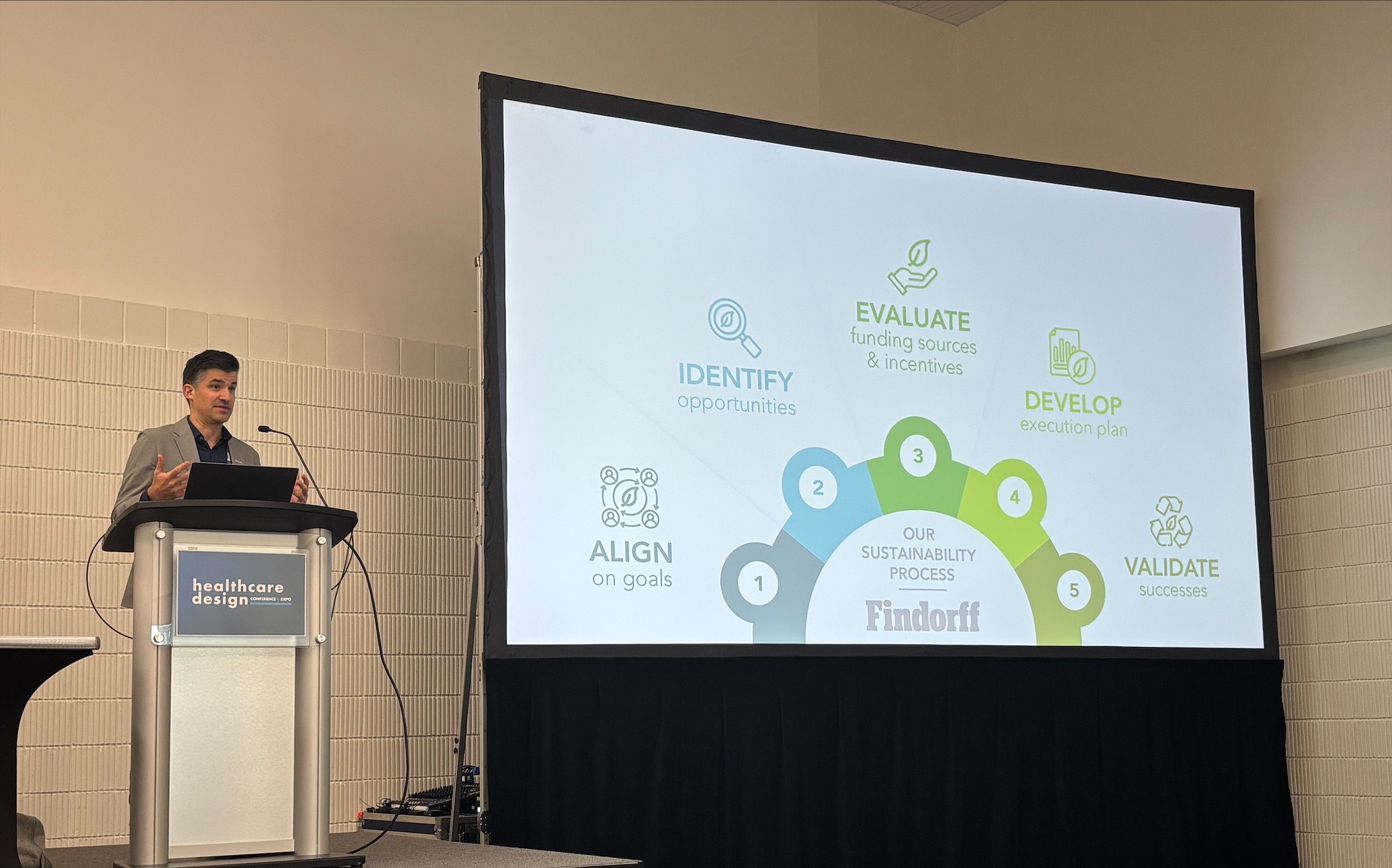
Sustainability Manager Ben Austin presenting at the national Healthcare Design Conference & Expo.
A unique approach to wellness
The over 90,000-square-foot SSM Health Sun Prairie Outpatient Center includes eye care and outpatient surgical services with an ambulatory surgery center, eye clinic, pharmacy, optical laboratory, and retail optical services. But wellness is incorporated in ways far surpassing the building’s important function.
Throughout the design and construction process, the project team prioritized a number of wellness and sustainable strategies, including:
- Carbon reduction
- 1,900 solar panels covering the parking lot
- Democratizing daylight (providing natural light opportunities for all employees, not just in executive offices or certain parts of the building)
- Recycling and waste diversion; use of reclaimed materials
- Tree preservation and land restoration
- Community engagement, such as through a tree planting initiative
SSM Health Sun Prairie Outpatient Center was designed and built to achieve WELL Platinum, a unique certification that focuses on well-being and wellness of a building’s occupants. Achieving WELL certification is rare: there are currently four WELL-certified buildings in Wisconsin, none of which are Platinum. Unlike LEED certification, which remains with a building through its life, owners must reapply for WELL certification every three years to maintain their status.
Findorff played a key role in tracking sustainability metrics, coordinating WELL requirements, and ensuring the infrastructure necessary to support the facility’s renewable energy systems was successfully integrated into the project.
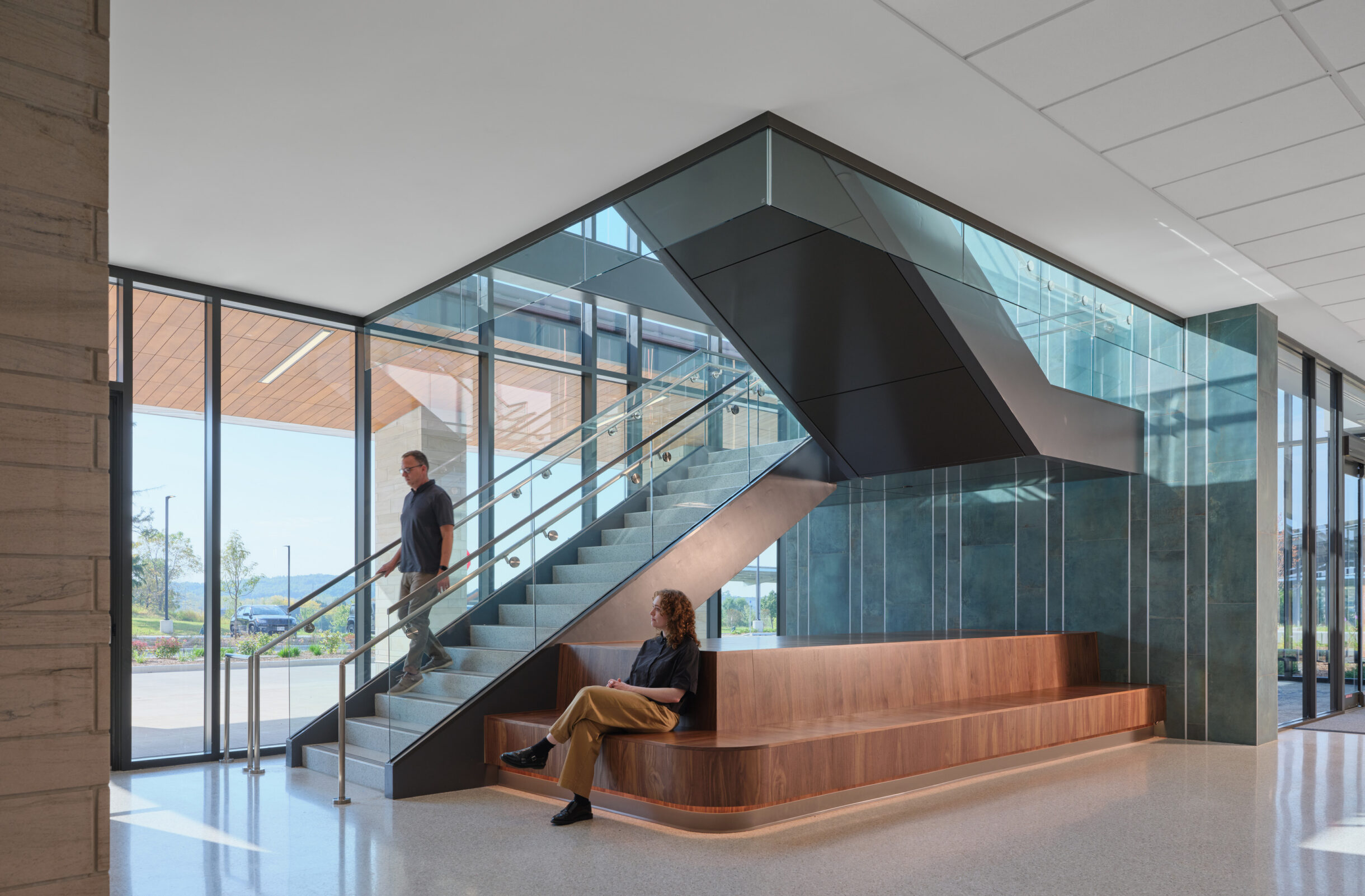
A custom lobby bench was crafted from repurposed wood, sourced from trees that had previously been on-site.
The Sun Prairie project expands on SSM Health’s growing leadership in healthy buildings. Its South Madison Campus became Wisconsin’s first WELL-certified healthcare project and the largest WELL-certified healthcare facility in the United States, while SSM Health was recognized with the International WELL Building Institute’s Rising Star Award for its commitment to advancing WELL at scale.
These efforts reflect the project’s broader commitment to environmental stewardship and creating meaningful connections between the building, its surroundings, and those engaging with the space. Incorporating sustainability into construction can create a lasting impact, and for healthcare facilities, it can promote wellness in an entirely new way.
Images © Tom Harris
Organizations advancing deep tech innovations, such as radiopharmaceutical production, fusion energy, advanced nuclear applications, and other emerging technologies, face unique challenges as they move from innovation to operation. These projects often involve specialized equipment, complex regulatory requirements, accelerated schedules, and significant capital investments.
To support clients navigating these complexities, Findorff provides strategic advisory services to help:
- Define the business need by aligning growth, capacity, and goals.
- Assess risks early including procurement, equipment delivery, startup, and operations.
- Determine the project roadmap by identifying key components, milestones, stakeholders, and aligning decisions to business objectives.
- Integrate facilities and operations through equipment, commissioning, qualification, and operational readiness.
Rather than focusing solely on design and construction milestones, our Strategic Advisors work as an extension of the owner’s team to help bridge the gaps between project planning, operational success, and future growth.
As Findorff’s newest Strategic Advisor, Jessica Giffey helps lead and strengthen this work.
Jessica has 15 years of experience designing, leading, and operationalizing advanced technical facilities, including particle accelerator manufacturing, radioisotope production, and neutron imaging environments. In her new role, she brings practical insight into early planning discussions and helps translate operational requirements into informed facility decisions. Her experience helps clients evaluate risks and opportunities and plan for growth as technologies evolve.
Learn more about our science & technology and industrial & advanced manufacturing expertise.
Findorff’s virtual design and construction (VDC) team recently took the stage at the Commercial UAV Expo in Las Vegas. Carter Mahnke and Chris Gibbs presented “Aerial Accuracy: Concrete & Façade Analysis,” sharing how Findorff uses drone technology to support deck pour and façade analysis. The presentation brought together to learn about using accurate visual information to strengthen how project teams plan, communicate, and build.
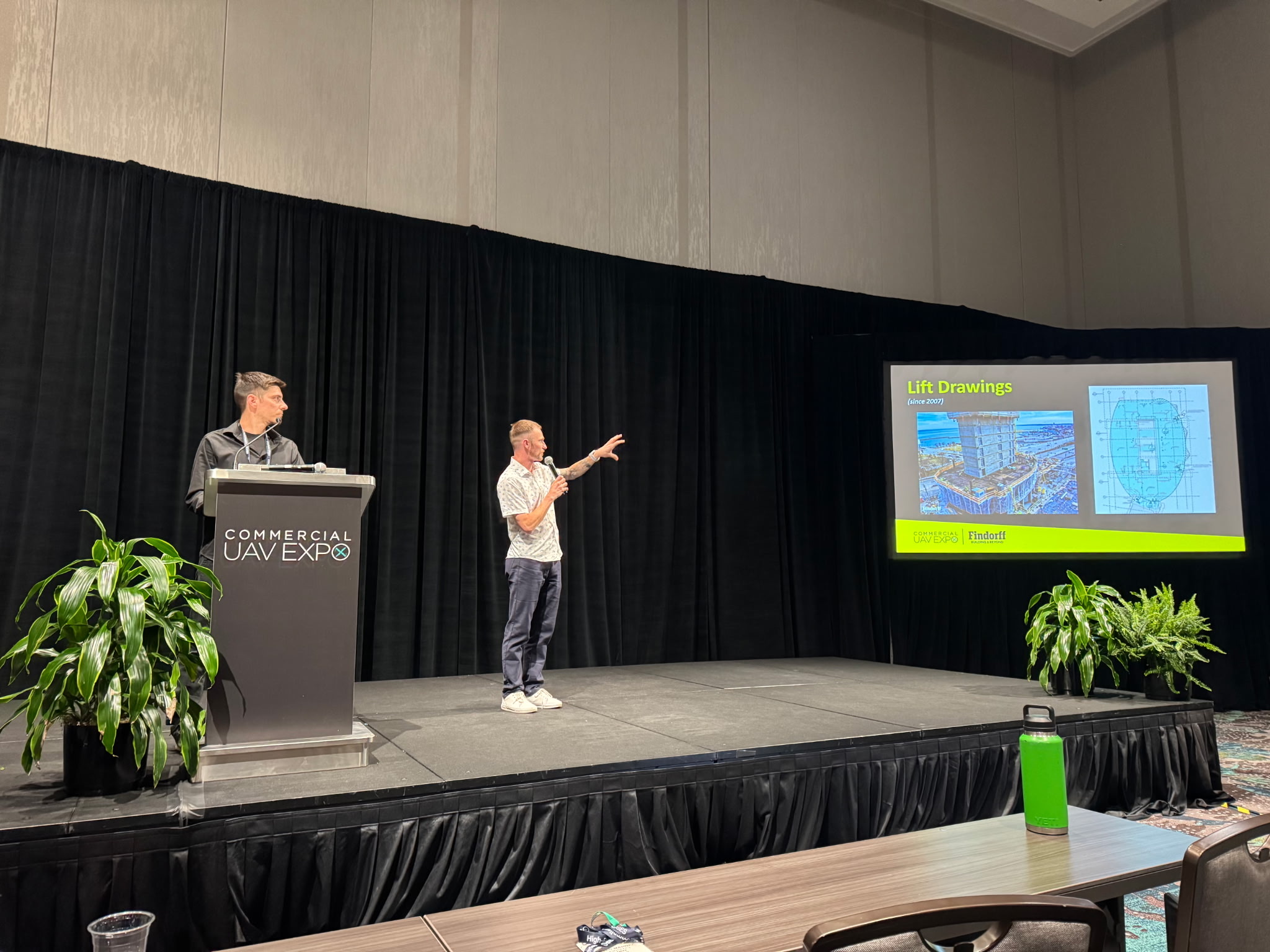
Chris Gibbs (left) and Carter Mahnke (right) presenting at the Commercial UAV Expo.
VDC can add value well before work starts in the field. Findorff’s capabilities include coordination lift drawings, laser scanning, and drone overlays, which can help teams compare conditions with project information and identify items that need attention. In the case studies presented at the conference, aerial data supported vapor barrier checks, window alignment, façade review, slab edge, embeds, and sleeve locations. Across all types of projects, VDC provides vital information that can positively impact:
- Communication
- Cost savings
- Documentation
- Safety
- Schedule
- Quality
- And more
Technology has drastically evolved construction and provides immense value — both for the people building the work as well as owners. VDC provides accuracy and insights that can ultimately save time and money throughout the course of a project. In the video below, voices from the field share their perspective on how aerial information supports construction teams. Their insights demonstrate how innovation and field experience can work together to create clearer information and better-informed project conversations.
See how Findorff’s VDC team is using drone technology, laser scanning, and visual overlays to bring greater clarity to construction.
Congratulations to these talented individuals on their recent promotions at Findorff! We are grateful for the hard work and commitment they bring every day, and we look forward to their continued success in their new roles.
- Larry Baker, Senior Superintendent
- Tyler Brovelli, Project Manager II
- Ethan Buechel, Project Manager I
- Derek Burdick, Director of North Central Operations
- Jessica Darling, Senior Communications Specialist
- Mike Fehrenbach, Senior IT Support Technician
- Tyler Genz, Assistant Preconstruction Manager
- Will Harris, Assistant Project Manager
- Erik Ivers, Project Executive
- Lee Lathrop, Hydro-Mobile & Scaffold Supervisor
- Joe Nelson, Supervisor
- Brandon Roeker, Assistant Project Manager
- Colin Schiesl, Assistant Project Manager
- Brennan Sullivan, Assistant Project Manager
- Ben Wolff, Supervisor
- Brent Yahn, Supervisor
Preparation is an underlying, constant theme in the school world. Educators prepare students for the upcoming quiz, the state test, the next grade, and beyond. Leaders prepare educators for changes in the school building. And when new technologies and new trends emerge, districts flow these things into an existing question: How do we continue to prepare students for the future?
AI is rapidly advancing and shaping not only our day-to-day lives, but entirely new jobs. It’s coming into conversations about career readiness and understanding what skills the next generation needs to hone and develop. Districts are often considering and implementing brand new AI policies while simultaneously continuing to assess how to best set students up for success.
These are big topics for a sole superintendent or district leader to work through, let alone “solve.” But coming together, joining other leaders who are facing the same questions and uncertainties, and witnessing innovation firsthand can help make the future of AI feel more tangible and clear.
Facility Field Trip to Morgridge Hall
On September 23, district leaders across Wisconsin joined the Findorff Facility Field Trip as part of the 2026 Wisconsin Association of School District Administrators (WASDA) Fall Conference. The field trip toured Morgridge Hall, home to the University of Wisconsin–Madison’s brand-new College of Computing & Artificial Intelligence (CAI).
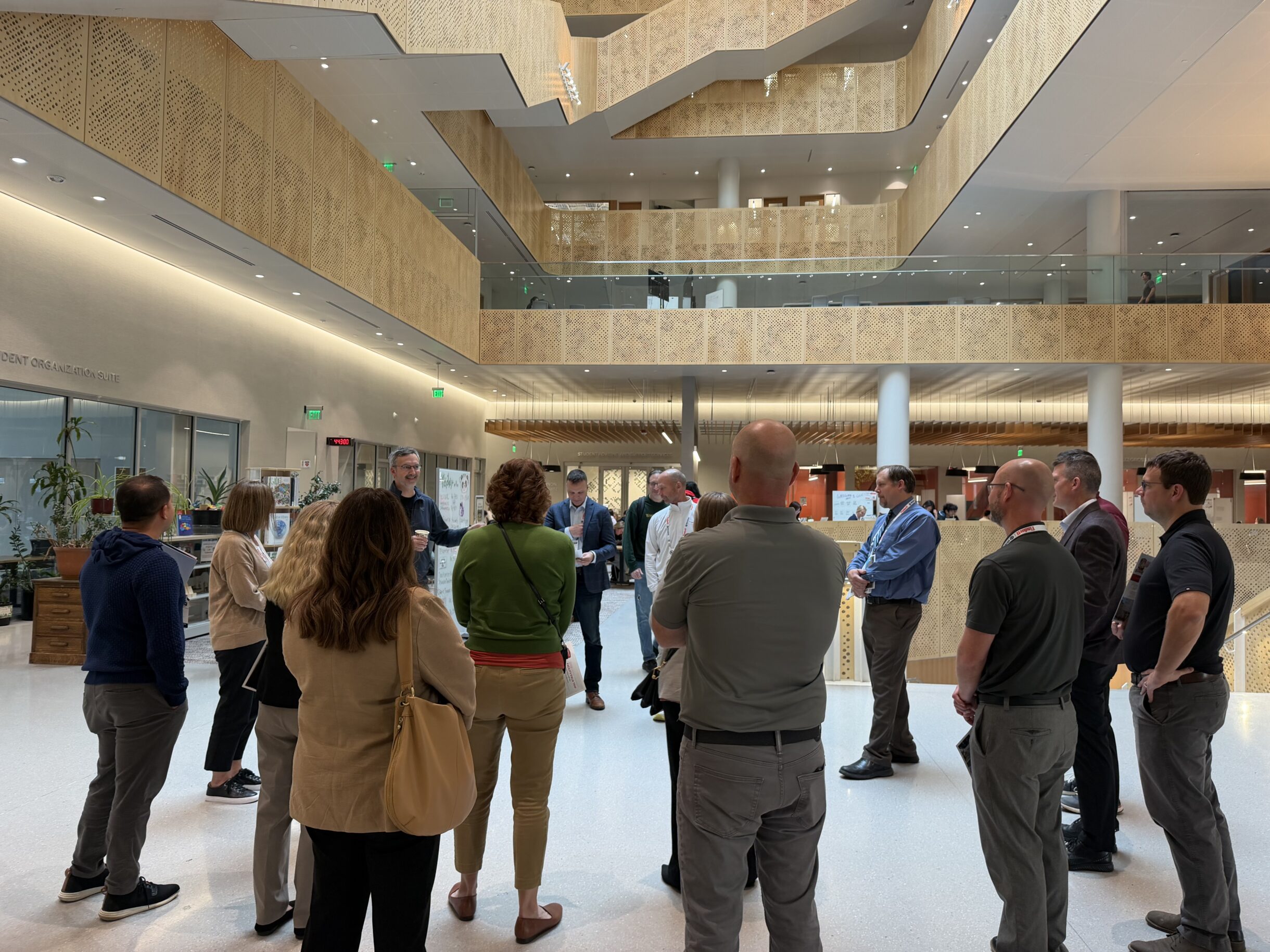
Attendees listen to Dean Remzi Arpaci-Dusseau.
Guests learned about CAI’s mission and creation, as well as heard insights on AI in education and emerging trends. The tour offered a behind-the-scenes look at spaces that are designed to encourage collaboration, innovation, and new discoveries, and great discussion ensued with CAI Dean Remzi Arpaci-Dusseau.
In talking about preparing students for higher education and the impacts of AI on learning, Arpaci-Dusseau shared that students still need to be curious and willing to struggle to solve problems, and they shouldn’t rely on technology to answer all their questions. Arpaci-Dusseau also reinforced that educators can learn from students, and that he consistently learns from his own.
When asked what K-12 schools should be teaching students to succeed with AI and computing, Arpaci-Dusseau’s answer was straightforward: the fundamentals. Reading and writing are so critical to a student’s success, regardless of what the computing needs may be.
About Morgridge Hall
Morgridge Hall is a 343,000-square-foot, seven-story facility that is dedicated to computing and AI. With more than 1,000 classroom seats, 300+ offices, flexible learning spaces, and tech labs, Morgridge Hall is a hub for research, learning, and collaboration. But the facility is not just unique for housing a one-of-a-kind, tech-centric college. “This building is the most sustainable academic building on campus,” says Cindy Torstveit, Associate Vice Chancellor of Facilities Planning & Management at UW–Madison.
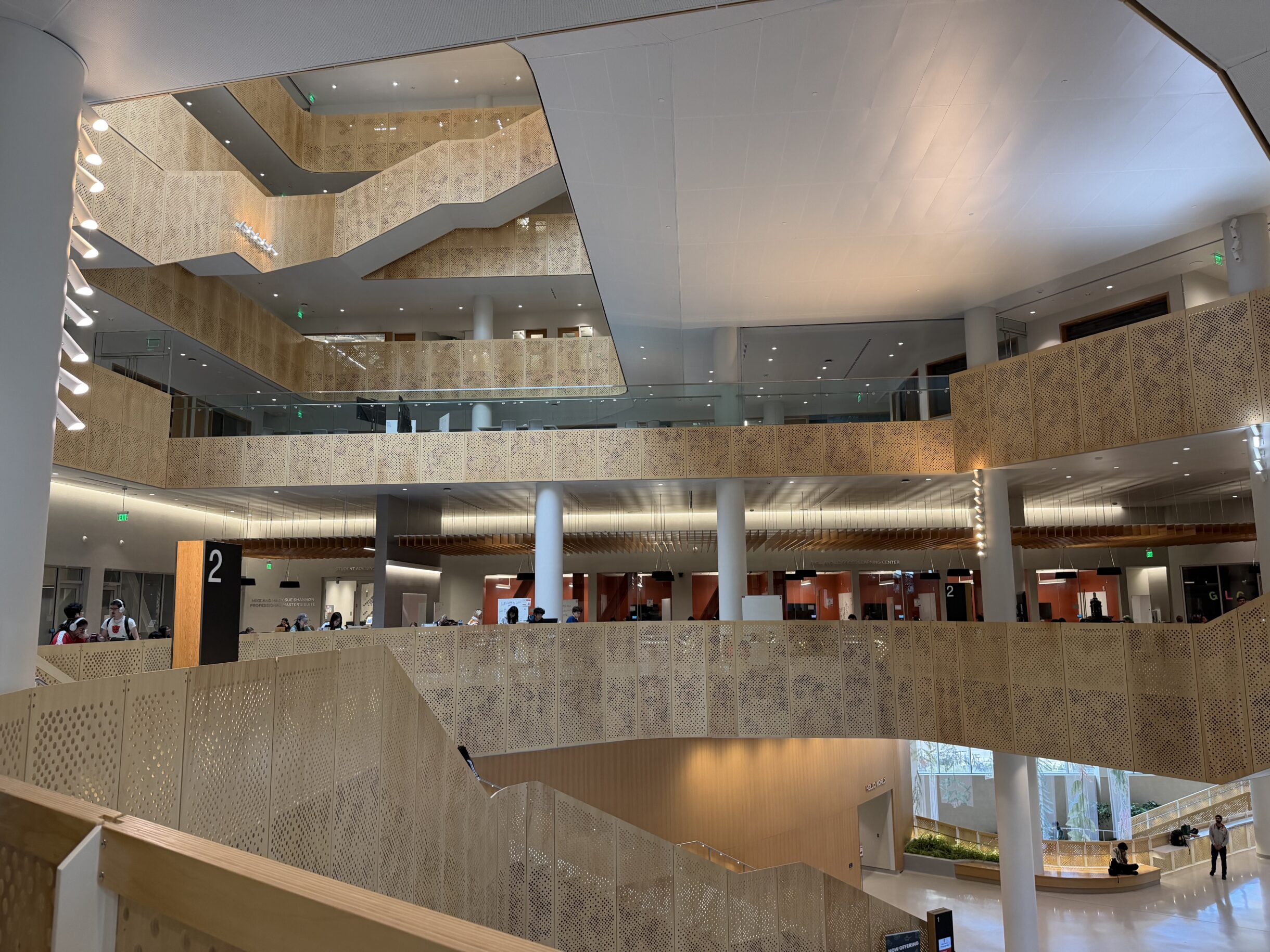
Morgridge Hall achieved LEED v4 Platinum in 2026, a testament to its sustainability.
This is intentional, as the very fiber of Morgridge Hall is rooted in innovation and serving future generations. Sustainability features of the building are as forward-thinking as the programs offered within its walls. A stormwater retention system for plant irrigation and toilet flushing plays a significant role in reducing about 30 percent of indoor water use. Intentional design with lighting reduces about 60 percent of energy consumption, and more than 300 solar panels help offset energy costs. Visitors often comment on how “green” the building is in a more literal sense: 25 percent of the site area is covered in plants, the majority of which are native to Wisconsin.
Earlier in 2026, Morgridge Hall received recognition for its sustainability, achieving LEED v4 Platinum certification — the highest LEED achievement possible. Morgridge Hall is a testament to not just preparing students (and the building itself) for the future but rather embracing it.
While questions about AI will inevitably remain, continuing conversations and exploring real-world applications helps district leaders — and all of us — prepare for the future and know what’s possible.
Learn more about Morgridge Hall and Findorff’s sustainability initiatives.
Hero image by Bruce Damonte
Findorff has been proud to partner with clients and communities throughout North Central Wisconsin. Our work spans projects of all sizes and serves a variety of industries, including K-12 education, healthcare, industrial, higher education, government, science & technology, food & beverage, and corporate. As our work and relationships in this region grow, we are expanding our leadership team. These new team developments will ensure we continue delivering exceptional service, strengthening partnerships, and supporting the community.
- Joe Schuchardt is retiring at the end of 2026. Joe’s impact on Findorff extends far beyond the projects he helped build. Throughout his career, he played a pivotal role in establishing Findorff’s Wausau office nearly a decade ago and growing relationships across North Central Wisconsin. Known for his leadership, passion, and deep commitment to the region, Joe leaves an enduring mark on the many individuals and organizations who have had the opportunity to work with him.
- Derek Burdick now proudly serves as Director of North Central Operations, providing strategic and operational leadership for the region while continuing to focus on client relationships. With 20+ years of industry experience, Derek is also deeply involved in a variety of regional trade associations and nonprofit organizations.
- Matt Femal will continue in his role as Project Executive, focusing on project management operations and will take on additional leadership responsibilities for the office. Matt has 17 years of industry experience, and is passionate about developing people, relationships, and projects, and volunteering in the community.
- Angel Laidlaw joined the Findorff team as the first Business Development Manager for North Central Wisconsin. Her background includes economic development and advocacy for Central Wisconsin. Angel previously served as President & CEO of Centergy and President of the Heart of Wisconsin Chamber of Commerce. She is also Chair of the Opportunity Development Centers Board and a member of the Wisconsin Economic Development Association Board.
Visit our Wausau page to learn more about our projects and expertise.
By Jeff Tubbs, Executive Vice President of Business Development
Community has always been a cornerstone of all that we build at Findorff. For more than 136 years, our commitment has gone beyond the jobsite, extending to the people, neighborhoods, and organizations that make Wisconsin a great place to live and work. Few partnerships reflect that commitment more than our longstanding relationship with United Way of Dane County, an organization that has helped strengthen our community for generations and one that Findorff has proudly supported for more than 100 years.
Findorff’s history of giving goes back to its founding, with century-old records documenting support for organizations that have helped define Dane County for generations – including the United Way of Dane County. For decades, Findorff leaders have stepped forward to help lead United Way’s annual campaign. The tradition began with Milton Findorff, who served as Campaign Chair in 1932, and was carried forward by former Chairman and President Rich Lynch in 2010. This year, I’m honored to serve in that same role as the 2026 Campaign Chair.
All of us at Findorff share a fundamental belief with United Way CEO Renee Moe, staff, and the nonprofits that comprise the organization: when we invest in our neighbors, those connections help build a stronger Dane County.
At Findorff, we often say our business is built on relationships, and we build upon them by continually showing up, listening, and earning trust over time.
The same philosophy applies to our communities. Strong communities aren’t created by any one nonprofit, one business, or one individual. They are built through connections between people who choose to help one another. That’s exactly what makes the United Way so important.
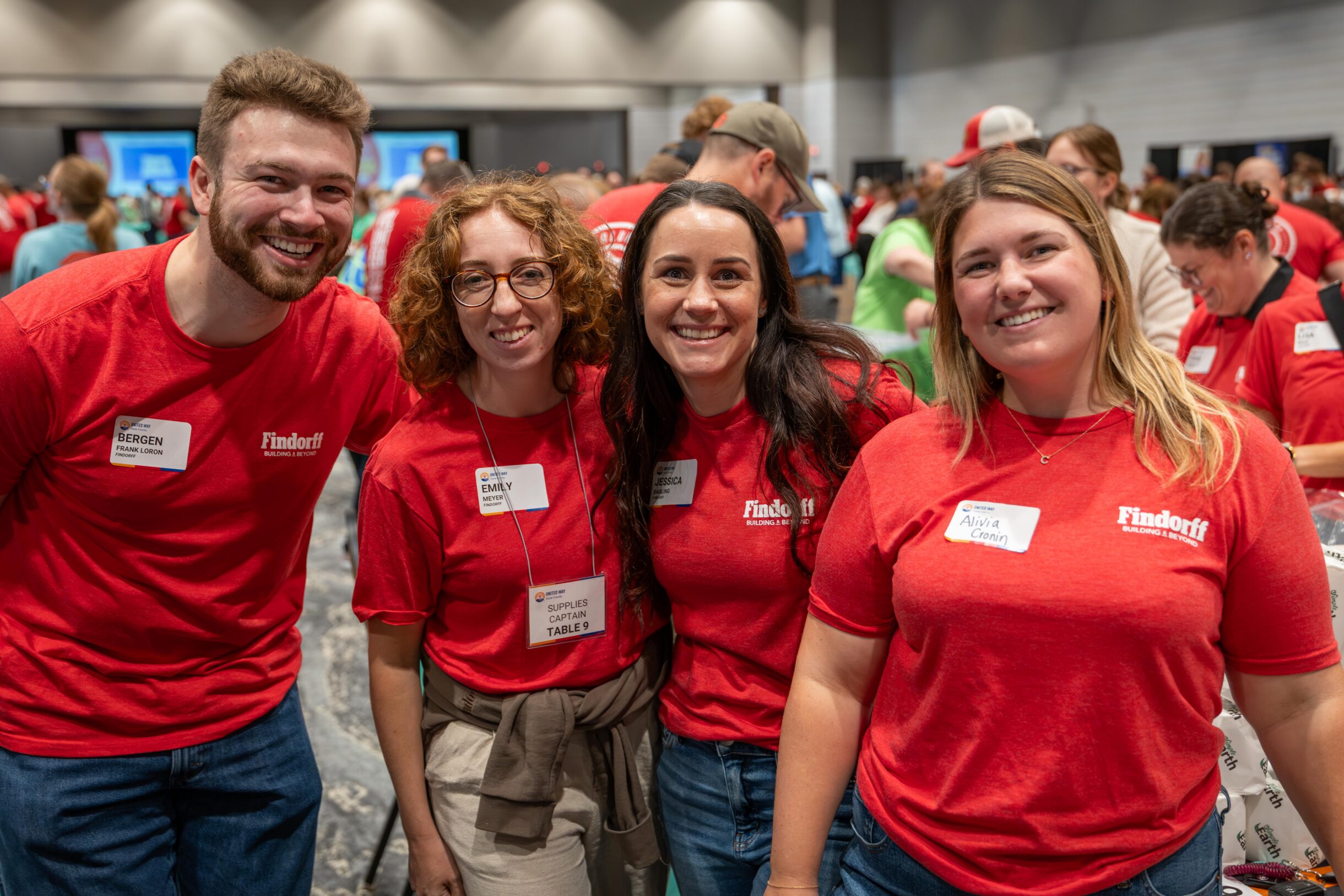
Findorff employees participating at United Way of Dane County’s annual Day of Caring.
The United Way of Dane County brings together businesses, nonprofits, and government and community leaders to identify our community’s greatest needs and invest where those dollars can make the biggest difference. It serves as a connector, helping ensure resources reach the people who need them most while bringing organizations together to solve challenges that no one can tackle alone.
This year’s United Way of Dane County advertising campaign theme, “Crisis Is Closer Than You Think,” is a reminder that the people facing these challenges aren’t strangers. They’re our coworkers, neighbors, families we meet at the grocery store or at youth sporting events. Many work full-time yet still struggle to afford housing, childcare or transportation. Others are navigating unexpected hardships that could happen to any of us. The need is real, and it is closer than we sometimes realize.
Last year, United Way of Dane County raised more than $18 million to support our community. It’s an incredible accomplishment, but we know it’s not enough.
For Findorff, supporting United Way is just one part of a much broader commitment to community engagement. Each year, we partner with more than 350 organizations across Wisconsin, and our employees serve on nearly 150 nonprofit boards and committees. We encourage our people to volunteer, to lead, and to invest in causes they care about, because we believe communities are strongest when businesses like Findorff go beyond building.
That philosophy has been passed down from one generation of Findorff leaders to the next, and it’s one I’m proud to continue.
As our United Way campaign begins, I’d like to thank everyone who has supported United Way over the years. If you’ve never participated before, I hope you’ll consider joining us this year – whether you’re volunteering on behalf of United Way, participating in your company’s pledge opportunity, or advocating in another way. Every connection matters – because when we come together to strengthen our neighbors, we all contribute to building a stronger Dane County.
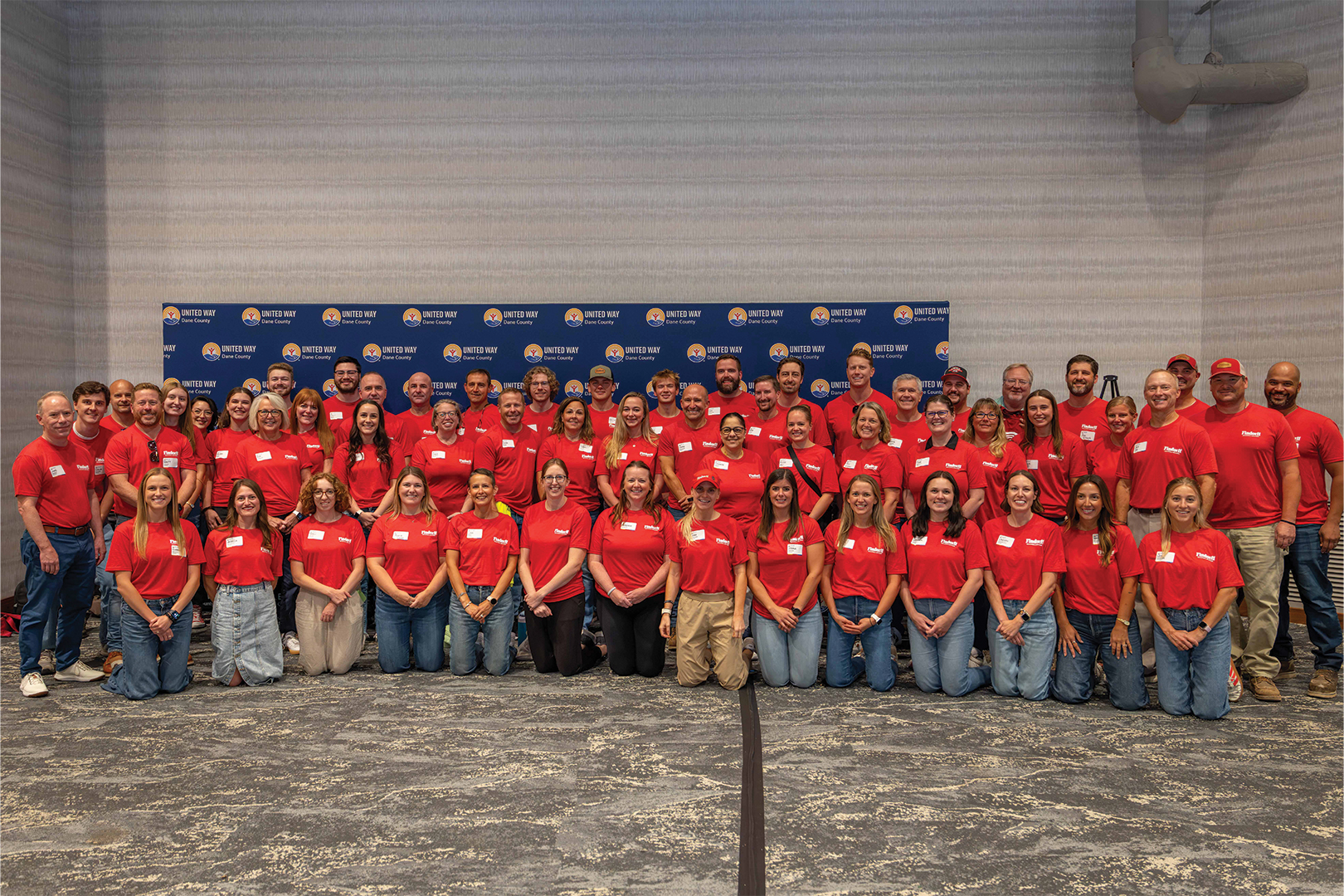
Findorff is honored to continue our 100-year partnership with United Way of Dane County.
Congratulations to these talented individuals on their recent promotions at Findorff! This achievement is a true testament to their hard work and dedication.
- Anna Arcuri, Assistant Project Manager
- Todd Bray, Supervisor
- Adam Ciseweski, General Superintendent – Wausau
- Konner Hellenbrand, Project Manager I
- Jason Henkins, Project Manager I
- Cole Oberle, Project Manager I
- Ritesh Pathak, Project Manager I
- Bob Pratt, Project Manager I – Client Relations
- Tiffany Schroeder, Special Projects Group Lead
- Brett Severson, Project Manager I
- Savanah Skack, Assistant Project Manager
- Isaac Thums, Supervisor
- Tony Zittlow, Senior Superintendent
Community impact has been a cornerstone of Findorff’s more than 135-year history. For generations, we’ve remained committed to building up our communities beyond the construction site by investing in the places where we live and work.
We’re proud to partner with more than 350 community organizations that share our values and help create lasting impact through a variety of different focuses:
- Education and literacy
- Environment and sustainability
- Food security
- Health and well‑being
- Housing stability
- Music and the arts
- Workforce development
- Youth initiatives
Being an integral part of this community means showing up, staying involved, and working together to make a difference. To reaffirm that long-standing commitment, Findorff created a new role within the company: Community Relations Manager, focused on deepening connections and expanding our involvement.
Leah Linscheid has been named to this role, bringing nearly 15 years of community experience, a deep knowledge of and appreciation for the communities we serve, along with an understanding of the impact thoughtful community engagement can have. As Community Relations Manager, Leah will lead Findorff’s efforts to build meaningful partnerships, coordinate community investments, and serve as a connector between the company, nonprofit partners, and the communities we call home.
Our investment in this role reflects a belief that strong communities are built through relationships, listening, and continued presence. At Findorff, we’re grateful to work alongside our partners to support initiatives that make a positive difference today and for generations to come.
Learn more about Findorff’s community involvement and the work we’re doing across Wisconsin.
Since 2020, Findorff has been recognized as Wisconsin’s Top Green Builder. We are honored to hold that title, ever motivated to find ways to reduce our carbon footprint — on our jobsites and beyond.
We provide sustainability services that empower our clients, so that they may make informed decisions that positively impact their buildings, both now and in the future. We enact initiatives that improve sustainability across our company operations, from net-zero energy solutions to electric vehicles and more. And we extend our commitment to sustainability throughout our community, sharing resources and dedicating time to organizations that strive to make our planet a better place for all.
On Earth Day and every day, Findorff cares about sustainability and doing what’s right. Check out our sustainability video to learn more.