
Nearly every school district across Wisconsin is experiencing a similar challenge: declining enrollment. One of the many implications of this trend involves a district’s infrastructure, and district leaders must find ways to manage underutilized facilities. With thoughtful planning, good communication, and help from strong facility planning partners, districts can work with their communities to find the best route forward.
What’s Causing Declining School Enrollment?
Declining school enrollment is not only a Wisconsin trend, but one seen nationally as well. Over the past two decades, the U.S. has seen an overall decline in birth rates: there are simply fewer students now than there were in 2006.*
As a result, declining enrollment is forcing school districts to rethink the way they use their facilities, particularly if buildings are under capacity or underutilized. When school buildings operate below capacity, districts must pay operational and maintenance costs (the latter of which are often more expensive) that could otherwise be avoided, and resources can be unnecessarily stretched. This results in higher spending per pupil with less educational impact. To address this, districts must develop holistic, cost-effective solutions while continuing to serve their communities well.
What is Rightsizing and How Can It Help?
When it comes to facility planning, rightsizing for school districts means aligning current and future enrollment with the amount of space needed for a school’s educational, co-curricular, and any other needs. Rightsizing looks at data to see how buildings are being utilized, as well as a building’s overall condition. The process of rightsizing helps districts answer what the “right size” of buildings or facilities is for a district population.
Rightsizing educational facilities can:
- improve operational costs and efficiencies
- redirect funds to improve active facilities
- redirect funds to a district’s overall budget (over time)
Rightsizing isn’t solely defined by the closure of buildings, but school consolidation or closure can be a component of it. For other districts, rightsizing may include expanding a district’s spaces for teaching and learning, such as if their enrollment is increasing. In one Wisconsin school district, a facilities solution involved both consolidating schools and building new.
Consolidating Schools for Success: A Case Study
A mid-sized school district was experiencing enrollment levels nearly 20 percent lower than the decade prior. At the same time, the district had recently retired a significant portion of its debt, creating a window to address long-term facility needs without exceeding historical tax rates. District leaders partnered with external experts — including EUA and Findorff as construction manager — to develop a comprehensive, long-range facilities plan.
Driving Decisions with Data
A good first step in facility planning and the potential for rightsizing is to understand a district’s enrollment. This district worked with the University of Wisconsin-Madison Applied Population Lab to assess past, current, and projected future enrollment trends. The results reflected declining population overall, not just the student population. However, the district’s oldest building, an elementary school, is in an area that could accommodate the most growth. This presented an opportunity to not only replace the oldest building, but also to align rightsizing tactics to match a growing area.
It’s worth noting that building a new elementary school in this area had been a point of interest for decades within the community. A referendum in 2009 and 2019 sought to build new, but the question failed both times. In 2023, there was now additional data to support a new elementary school as a potential solution. District buildings were assessed for structural integrity, educational adequacy, capacity, and maintenance costs.
From these findings, a few buildings were identified with the highest needs and, with rightsizing considerations, would make the most sense to close:
- Two elementary schools
- The oldest elementary school, to be replaced with a new one
- The educational service center, which could consolidate into the high school building
- An early education center, which could consolidate into two existing elementary schools
By closing buildings, the district would avoid more than $50 million in deferred maintenance costs over a 15-year period that would otherwise go toward keeping them open and operational. But moving forward with any potential solution would require community support.
Community Outreach and Engagement
As is the case with any potential facilities solution, simply hearing community concerns and priorities isn’t enough. Districts must also take action to address them. The superintendent worked tirelessly with staff, had a presence at all the buildings, and additionally had focused conversations with municipal leaders to get everyone on board.
Ongoing district communications were steady throughout the planning phase and took community feedback into account, and communications efforts expanded even further once a referendum was approved by the Board. The district, EUA, and Findorff enacted several strategies throughout planning to spread awareness and gather feedback:
- District-wide community survey: More than 1,600 respondents provided feedback on their priorities for facilities and if they would support a referendum (and for how much).
- Community & Staff Conversations: Eight sessions engaged both community and staff members at multiple points in the facility planning process.
- Referendum roadshow presentations: The district superintendent gave 45 presentations throughout the district’s municipalities (nearly 10 in total), across 105 square miles.
- Board meetings/workshops: Fifteen were held with a specific focus on facility planning.
- Communications materials: Ads, fact sheets, display boards, direct mail, and more were disseminated throughout the district.
Crucial to the district’s success was the involvement and active presence of the superintendent. They presented nearly 50 roadshows, posted up at coffee shops to be available to residents looking to chat, sent continual emails and made phone calls to connect with staff and community members, and more. The superintendent additionally got in front of staff immediately to answer questions and share transparent info on what they could expect.
First Successful Referendum in More Than a Decade
In November 2024, the district passed its first school referendum in over a decade with 58 percent of the vote. Rightsizing district infrastructure can come with challenges, but can ultimately provide solutions that make the best long-term fiscal sense.
Key Takeaways When Considering Rightsizing and School Consolidation
The decision to rightsize and/or consolidate buildings is not an easy one. So much life and learning happens in a school building, and it’s incredibly challenging to consider closing one. But there can be long-term advantages that better serve a district, which, in turn, can better serve its students, families, staff, and a community at large. When districts reach a crossroad, there are some important factors that can help forge a path forward:
- Let data guide and inform decisions. Rightsizing buildings is a large investment of time and effort, and it is critical to utilize data to support facility planning. Plus, data will help garner community support and tell a district’s story.
- Be open and transparent with the community. In an environment where emotions can run high, transparency is key. It’s important to create touchpoints for the community to offer their input — and equally important for that feedback to be taken seriously.
- Find a vetted, trusted facility planning partner. Superintendents and other school leaders already have an incredibly challenging job in running their district without a potential referendum on the ballot. Partnering with experts who are well-versed in facilities assessments, K-12 construction, and referendum strategy can help guide your district to rightsized success.
*https://pmc.ncbi.nlm.nih.gov/articles/PMC11537490/
This article was originally published in the October 2025 edition of Wisconsin School News.
The realities facing rural Wisconsin school districts are challenging. Some need millions of dollars in improvements across multiple facilities. Others haven’t passed a capital referendum in decades. Low enrollment levels can leave school boards with urgent infrastructure needs and inadequate budgets to fund them. But with careful strategic planning and thoughtful community outreach, these challenges can be successfully overcome.
Early starts = Better results
For rural school districts, facilities maintenance and improvements can present unique opportunities. Aging infrastructure, fluctuating enrollment, and leadership transitions can all complicate long-term planning. Building awareness, particularly among residents without direct ties to school districts, can be another tricky task. Tight budgets linked to enrollment levels further complicate matters, requiring school boards to invest wisely in only the most effective tactics.
To overcome these obstacles, school boards must embark on careful, long-term planning early in the process. That means starting preliminary assessments 12-24 months before a potential referendum date.
The school districts of Westfield and Jefferson offer incredible examples of successful community outreach campaigns. By carefully developing data assessments and smart communication strategies, launching key partnerships and planning leadership transitions, these districts were well positioned for successful outcomes.
Westfield: A comeback story
Tucked away in pastoral Marquette County, the School District of Westfield faced a daunting challenge. Its facilities were in such a deteriorated state that its long-time property insurance provider declined to renew coverage. Leaks in the high school’s plumbing were costing millions in emergency repairs. Large systems like HVAC units, boilers, and water softeners were failing across multiple schools. Without funding, the future looked bleak.
The district faced a second big hurdle: Westfield hadn’t passed a referendum in 30 years. Adding to that, both the district administrator and business manager were transitioning out of their positions.
With a total enrollment of 1,000 students, a limited budget and a vast community spanning 22 municipalities, how would Westfield leaders manage to build trust, raise awareness, and mobilize community support to meet the district’s funding needs?
Westfield’s journey began two years before holding a referendum. By starting the planning process far in advance, they set themselves up for success. In 2022, Westfield’s first step was hiring Findorff to guide long-range facility planning, including a comprehensive facility study. These efforts, combined with bringing on Somerville Architects & Engineers for the educational adequacy, capacity, and utilization analysis, laid the groundwork for a strategic communications campaign designed to engage the community and address decades of deferred maintenance.
The focus turned to the impending leadership changes. Leadership upheaval can cause significant disruptions to the progress of capital improvement projects. The board thoughtfully hired replacements, District Administrator Michelle Johnson and Business Manager Veronica VanDerhyden, with deep ties to Westfield, both being born and raised in the region and graduates of the district. This ensured that district leadership retained a local connection at the highest levels.
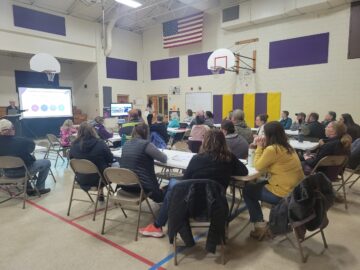
The Westfield School District hosted 12 community and staff meetings prior to their referendum, drawing more than 60 attendees to help shape the proposal.
Transparency and dialogue with residents, both in person and online, was critical. The district hosted 12 community and staff meetings in late 2023 and early 2024, drawing more than 360 attendees. These sessions helped shape the referendum proposal and ensured that community voices were heard.
A district-wide survey conducted in April 2024 revealed strong support for a $27 million referendum, with 61.5% of respondents in favor. The survey also identified preferred communication channels – newsletters, local newspapers, the district’s website and Facebook – that became the backbone of Westfield’s outreach strategy.
Partnering with Findorff, the district launched a robust, multi-channel communications campaign. Over 30 digital and print pieces were distributed, including articles from Johnson, referendum information sessions, newspaper ads, mailings, e-newsletters, social media updates, and website FAQs.
Visual storytelling played a key role, as did efforts to reach residents with no ties to the school system, accounting for 70-75% of eligible voters. For example, rather than simply stating that the pipes at school facilities were corroded, Johnson and other district leaders attended community events and displayed real samples of the school’s corroded plumbing. Many of these events provided residents without school-age children with first-hand understanding of the urgency of these improvements. Visually impactful tools like a corroded pipe offered a tangible, impactful message.

Real samples of Westfield’s corroded plumbing.
“Our focus with engagement was to help people see the role they play in our school system,” said Johnson. “Schools are a part of the economic health of the community, and we need all stakeholders to remember the value we bring to them regardless of their connection to our district.”
On election day, the results spoke volumes. In its first successful referendum in three decades, Westfield’s question passed with 62% of voter approval, marking a historic victory for the district.
The district credits its success with launching a campaign rooted in authenticity and responsiveness. The board proactively met residents where they live, congregate and scroll, ensuring that the right messaging reached the most people.
Today, construction is underway at Coloma, Oxford and Westfield elementary schools, along with the Westfield Area Middle/High School. The district continues to share progress updates through its website, ensuring that transparency remains a cornerstone of its relationship with the community. The Westfield project stands as a testament to the power of strategic communication, community engagement, and perseverance.
Jefferson: Framing a brighter future
The School District of Jefferson faced a different set of challenges: significant operational and facilities needs, declining enrollment and historic facilities with sentimental value for the community. The district, which serves 1,600 students across five schools, identified urgent facility needs that required costly repairs and upgrades. With mixed referendum results in the past, community engagement would be the key to success.
In 2022, Jefferson launched its “Framing Our Future Facilities” initiative, forming a Facility Advisory Committee comprised of 17 members representing a broad cross-section of the community. Findorff led the initial facility assessment, followed by collaboration with EUA for option development and long-range planning. Early survey data revealed strong support for the proposed improvements, signaling an optimistic future.
Construction needs were ambitious and far-reaching, touching all five schools in the district: Jefferson High and Middle Schools, East Elementary, West Elementary, and Sullivan Elementary. Proposed work included:
- Enhancing security at main entrances and fire alarm replacements for improved student safety.
- Upgrading and repairing several failing and inefficient building components.
- Modernizing learning environments with new high school agriculture and technical education labs to support hands-on learning.
- Renovating classrooms for more dynamic and flexible instructional environments.
The renovations were particularly complex and had to be mostly executed during the school year. This included 57,200 square feet of renovations at East Elementary, an early-20th-century building with deep historic significance to the community. Findorff assisted in developing a phased plan to ensure students’ safety and success were not negatively impacted, underscoring the need for careful planning and coordination behind these types of projects.
Like Westfield, Jefferson changed superintendents during the planning phase. In this case, a four-month long exit strategy facilitated a seamless transition. Charlie Urness, the new superintendent became the “face” of the campaign, leading community meetings, attending workshops, and speaking directly to residents. Highly visible leadership instills a sense of confidence, transparency, and partnership with the community, but broader district involvement is essential, too. Steady, engaged involvement by school board members, administrators, and principals helps amplify messaging, spread awareness, and build trust.
“We incorporated the phrase, Strong Schools = Strong Communities, into our presentations and communications,” said Urness. “The equal sign is vital because the statement/equation works both ways.”‘
The district’s extensive planning and communications strategies were a success. The referendum passed in November 2022, allowing construction to kick off in March 2023.
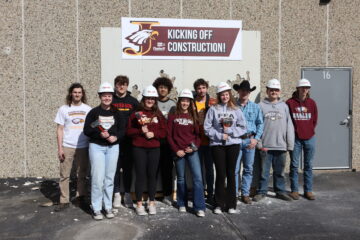
Students participate in the wall smashing event to kick off construction at Jefferson High School.
Jefferson’s outreach strategies weren’t a means to an end — they were the beginning of an ongoing conversation. After the referendum passed, the district continued informing the community with project updates to show how it had faithfully delivered on its promises and was investing taxpayer funds judiciously.
Another way in which Jefferson continued its community outreach was by involving students in the construction itself. By inviting students to participate in facilities demolition, site tours and other engaging activities, it helped students learn about the unique needs of educational infrastructure and encouraged the next generation to consider a career in the trades.
A blueprint for success
Both districts’ experiences illustrate how facility assessments are an essential first step in strategic planning and fostering community trust. For rural (or any) districts embarking upon their own referendum journeys, consider the following recommendations:
- Start with data. Assessments reveal urgent needs, guide prioritization, and provide vital information for future communications. Surveys reveal insights into the level of community support.
- Engage the community. Transparent conversations build support and shared ownership. Hold open houses. Attend local events and meet people, including those outside of the school system. Learn where residents congregate online, and share information there, too.
- Leverage partnerships. Experts in construction, architecture, finance, and demographics provide critical insights. Consider hiring a district communications professional to help manage external messaging and strategy, long before a referendum.
- Adapt to change. Leadership transitions are inevitable — continuity comes from clear vision and local commitment. Make smart choices to avoid disruption.
As districts across Wisconsin look to the future, the stories of Westfield and Jefferson offer a powerful reminder: with the right tools and voices at the table, even the most rural communities can achieve lasting progress and help support the next generation.
Erika Freeman is director of education market client services at Findorff. She can be reached at efreeman@findorff.com.
Black History Month is a time to celebrate and recognize the achievements made by African Americans. In recognition of Black History Month, we want to pay respect to African Americans who have paved the way to make our industry what it is today and we encourage you to check out some of the many events happening with your community!
Madison:
Madison Children’s Museum | Thursday, February 16 | 5 – 8PM
Free Night: Black History Month Celebration
Chazen Museum | February 6 – June 25, 2023
re:mancipation Exhibition
Madison Public Library, Central Library | Sunday, February 19 | 2PM
Love Released Again
Milwaukee:
UWM Student Union | Thursday, February 16 | 9:30 – 11AM
Black History Month Coffee Hour
UWM Student Union Cinema | Thursday, February 16 | 6 – 8PM
African American Film Series: Nope
Wausau:
Marathon County Historical Museum | Thursday, February 16 | 5:30 – 8:30PM
Trivia Night
Whitewater Music Hall | Friday, February 24 | 6 – 9PM
Black History Month Celebration
Findorff demonstrated true character and client commitment throughout the reimagination of the ProHealth Mukwonago Hospital completed earlier this year. By creatively orchestrating nearly 200,000 sq. ft. of work throughout this occupied facility during the last three years, we helped ensure that caregivers could offer patients continuous treatment in the existing facility, even with enhanced pandemic protocols.
Building & Beyond is the promise behind every project we take on, especially healthcare facilities where the vulnerable find care. Findorff completely transformed the former ProHealth Mukwonago facility, all while important procedures like cancer treatment continued to operate, requiring extreme accuracy, attention, and accommodations. We are incredibly proud of this project, and the ability to have played a role in caring for the community that ProHealth Care serves.
National Women in Construction Week is a week we love to celebrate and embrace at Findorff. There aren’t enough adjectives to accurately describe the exceptional qualities of the ladies who contribute to the success of our company. Each day, our Findorff women continue to break down barriers and prove that the sky is the limit for women in the construction industry. We’d like to thank all our dedicated, hardworking, and extremely talented ladies who make up the Findorff family.
Are you interested in learning more about what makes some of our team members proud to be in the industry, or advice they would give to another woman entering? We did a Q&A with some of the ladies on the Findorff team – see below to learn more about each of them, and some interesting insights and advice they have!
Q: What advice would you give to a woman in or entering the industry?
A: My advice would be to insert yourself and push yourself outside of your comfort zone. Before working at Findorff, I had no experience with construction so I’ve tried to ask as many questions as possible and volunteer for things that in my previous work experiences I usually wouldn’t do. (Rory, Project Engineer Co-op)
A: Be prepared to learn. There are so many different areas in the construction world. Finding your niche is key. (Kelly, Yard Operations Specialist)
Q: What makes you proud about working/being in the industry?
A: I’m proud to work in an industry that serves people in every area of life – from education, healthcare, arts, residential, and more. All to help make the world a better place. (Kamila, Project Engineer Co-op)
A: I am most proud knowing the struggles I face, and work through today will be less prevalent for women that come after me. Each competent woman builds upon the next one, and through our own examples we show that women can do this work. In doing so, we change the minds of those that might think women don’t belong in the construction industry. (Lynn, Journeyman Carpenter)
Q: What about being a part of the Findorff Family brings you the greatest fulfillment?
A: I strongly believe that my team motivates and supports me in completing my responsibilities and in achieving my personal career goals. The opportunity to take initiative with new responsibilities, and to work on great projects with amazing teams is the best part of being a member of the Findorff family. (Kshethra, Project Engineer)
A: I enjoy the journey. We work with great people… from the newest hire to field leaders and executives who have been here for decades. It’s fulfilling to grow in the company and see us grow and build amazing things. (Laura, MEP Group Lead)
Q: What is your favorite project you have been a part of or your favorite experience of a project you are currently working on?
A: I have been lucky to be on a lot of really cool projects, but my favorite project to date is the Meriter Child & Adolescent Psychiatric Addition & Renovation. It was a challenging project that had a lot of unique characteristics paired with a really great team. Ultimately the project was a success and the owner was happy. (Jenna, Project Manager)
A: I am currently enjoying being part of the team building Marquette University’s new College of Business Administration. It is always so fun to see a new building rise from nothing but a hole in the ground into a fully-fledged structure! (Justine, Assistant Project Manager)
– Ben Austin, Findorff’s Sustainability Lead & Matt Zabel, Faith Technologies
Today’s facility environments are complex and can require active management to meet constantly evolving expectations. Building owners and operators must balance a wide array of needs across their portfolio and determine how their facilities and building systems can best support the goals of the organization. Central to these needs is a strategy to address energy efficiency, sustainability and resiliency within the building systems.
Findorff and Faith Technologies have long provided sustainable building solutions to our clients. Whether the goal is to reduce energy bills, assess renewable energy options, help meet climate goals or improve the resiliency of your facilities, system improvements can be worth the investment.
The tools and data provided by an Energy Monitoring System (EMS) deliver clear measurements for sustainability goals and give our clients the data they need to make informed decisions. While there are a variety of strategies available to facility operators, an EMS presents the most significant opportunity to reduce energy costs, while also helping to assess power quality issues before they make a negative impact.
An EMS requires centralized software that should have the following capabilities:
- Trending and database storage of energy usage
- Intuitive charts and dashboards that provide detailed information about the system’s health and chart real-time progress
- User-friendly reports that can be easily shared
- Alarming for down-time situations or issues that could lead to down time
For electrical metering, typical systems include a power quality meter at the utility entrance to the facility and power usage monitoring at key points downstream. Lower-level metering may be required by LEED, ASHRAE, or to measure specific sustainability goals. The system can also be used to drive further efficiency tracking.
For other metering, such as natural gas, water or compressed air, intelligent or pulse meters are placed at the facility feeds, as well as downstream if data for departments or processes need to be broken out separately.
While metering non-electrical energy sources can confirm usage and drive efficiency, there are several key benefits to monitoring an electrical system:
- Determining operational, process or equipment setting adjustments to lower usage or reduce peaks
- Alerting users to abnormal electrical conditions that would otherwise go unnoticed (i.e., power quality or peaks in usage). This helps avoid outages, down time or equipment failure
- Providing data in the event of a circuit breaker trip, to prevent recurrences
- Division of electrical bills, where allowed, to separate accounts or business division
- Support of green building standards or facility sustainability goals
Facility operators, armed with the information that an EMS provides, can assess their needs for the future. Typical questions we hear include:
- Where can we expand our facility with our existing electrical power distribution?
- How much energy is consumed compared to my other facilities or process lines?
- How much solar or other renewable power could our facility consume?
- How much energy does my new equipment use, compared to my old equipment?
Many clients question what the payback will be for an EMS at their site. This infographic shows some potential ROIs for a typical greenfield facility located in the U.S.Projected ROI for Energy Monitoring Systems
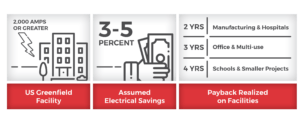
Facilities with very low utility rates or usage, or with one large electrical consumer tend to have longer ROI timelines. It’s almost always the most cost-effective to install metering equipment on a greenfield site during construction, rather than retrofitting an operating facility later, where shutdowns will be required for the installation. Brownfield sites with existing facilities are also good candidates for installing an EMS to better understand power consumption and develop energy usage plans to optimize building performance, while minimizing energy consumption. Here are some brief budget examples and projected ROIs based on typical energy rates and pricing from July 2021.
At Findorff and Faith Technologies, we provide our customers with technical solutions that drive results. An energy monitoring system helps customers reduce costs, prevent downtime and plan for the future. How can we support your energy monitoring needs?
Blog written by Josh Baysinger, Findorff Virtual Construction Manager
The way organizations do business is changing. In today’s digital age, information is easily accessible and digestible, requiring organizations to change the way they communicate. At Findorff, we are experiencing this firsthand. Our in-house Virtual Construction team has helped us adapt, allowing us to view what a space may look like before a shovel hits the ground.
Not so long ago, having digital plans in our hands through a tablet was mind blowing. We could virtually manage a building’s construction without pages and pages of blueprints. Digital plans are still part of our job, but we have evolved. Today, virtual construction is comprised of innovative practices, ranging from building information modeling (BIM) to augmented reality (AR), helping us coordinate building systems and analyze data.
To make this possible, we strategically leverage our top five virtual construction methods, which are:
- Look at virtual construction from different perspectives: Findorff’s virtual construction team is comprised of a diverse group. Our team has registered architects, licensed drones pilots, video-game technology experts, and those with direct field experience. Such expertise offers various insights into the construction process.
- Follow an integrated process: Through BIM and cross-functional collaboration, our data has a role in budgetary decisions, concept visualization, safety awareness, and field production. By integrating all steps, we are able to educate owners and facility staff about their new spaces.
- Use virtual construction throughout all project phases: From preconstruction to project turnover, virtual construction plays a major role. Early on, we create realistic visualizations that help building owners understand their facilities in terms of form and function. By the time construction is underway, we perform everything from sequencing studies to coordinating mechanical systems. This ensures our projects run efficiently and on schedule. Even after punch lists are complete and owners are ready to occupy their facilities, our team uses various tools to help building owners operate and manage their spaces.
- Create added value through technology: In today’s digital age, technology is king. By utilizing tools such as drones and advanced software, the value added can range from strategic site utilization to schedule analysis. In turn, we are able to foster efficiency and accuracy throughout design, construction, and operations.
- Collaborate with building owners and key stakeholders: Through virtual construction, we are able to develop renderings and animations, plus use AR. These practices allow building owners and key stakeholders to visualize their buildings. For example, we used AR for Pope Farm Elementary School in the Middleton-Cross Plains Area School District. In the image at the top of this page, the School’s future principal was able to preview a model of the space she was standing directly in during construction.
Using our methods with virtual construction can provide significant ROI, such as:
- Accurate estimates and potential reduction in construction costs
- Increased engagement with clients and industry partners for a better understanding of project goals
- Ability to anticipate building issues, which allows for solution planning before construction starts
- Visualization of a facility’s design to identify any necessary changes
- Seamless project delivery throughout the entire construction process
- Increased safety through the analysis of site conditions before and during construction
Such benefits can help your project stay on schedule and within budget. In the digital age, we are continuing to evolve, with the goal to be a valued resource and collaborative partner.
Want to learn more about how virtual construction is used in the industry? Check out this blog!
Blog written by Chad Eschler, Business Development
When people think of Wisconsin, what comes to mind may be the Green Bay Packers, cheese, brats, and the great outdoors. What may be news to some folks is that Wisconsin is also becoming a top destination to plant roots for science and technology businesses from across the U.S. Having lived here my entire life, I have seen this first hand as there is an increasing need for local state-of-the-art facilities to support research, innovation, technological advancements, and more!
Hearing this, you may be asking yourself, “why Wisconsin?” There are three main areas that answer this question:
- Accessible research: Our state has a wealth of knowledge. For example, the University of Wisconsin-Madison has been one of the top universities for decades and home to famous discoveries, ranging from Hector F. DeLuca’s research on vitamin D to Jamie Thomson’s research on stem cells.
- Growing career opportunities: We used to hear about the brain drain from Wisconsin. In my experience, this has lessened over the years with the increasing career opportunities offered by science and technology businesses coming into our state. For example, Madison is the third-fastest growing technology employment market in the U.S as described by the Milwaukee Journal Sentinel.
- Central location: Being positioned in the Midwest has made Wisconsin a viable place for science and technology. With its strong infrastructure and geographical location, Wisconsin is serving as a hub between the coasts.
Considering the science-based opportunities Wisconsin has to offer, specialized facilities are in demand by new businesses entering our state. With a pulse on the industry, Findorff adapted its approach to building science and technology facilities. We focus on five key areas:
- Understanding client needs: Not all science is the same. Nor are the building requirements for each project. Considering this, we start each project with the question of “why?” This ensures a clear understanding of our clients’ goals and needs.
- Recognizing FDA/cGMP regulations: During the early planning stages, we discover and analyze any necessary requirements that would impact construction. Often projects need to follow FDA/cGMP regulations. In these instances, we track all items that go into a project against specific facility and process requirements to ensure compliance.
- Supporting speed-to-market delivery: Once a product is approved, companies only have so much time to capitalize on patents. This drives us to build quality facilities through efficient scheduling.
- Building projects of all sizes: Findorff has the expertise to support various project sizes. A major asset that makes this possible is our Special Projects Group. It is experienced in remodeling, renovation, maintenance, and trades-related work. Often such efforts are even performed in occupied spaces so our clients’ staff can keep working. In turn, Findorff understands how to perform quality work, regardless of scope.
- Serving as a local resource: With nearly 130 years under our tool belts working in Wisconsin, we leverage an expansive network of resources that make Findorff more than a builder. We are a partner with local insight into how clients can achieve success both on and off the construction site. This is possible because of our skilled talent and array of services that we tailor to our clients’ needs.
To learn more about our efforts in the growing science and technology industry, make sure to check out several of our relevant projects.
Blog written by Findorff’s Sustainability Lead Ben Austin, LEED® AP BD+C, WELL AP, Fitwel Ambassador
Today is Earth Day! At Findorff, this day reminds us of how sustainability is a driving factor in what we do. We strategically look at sustainability to offer innovative solutions and a holistic approach in construction. Ranging from assessing environmental impacts to how we do business, these efforts make meaningful differences where we all live, work, and play.
In staying true to such objectives, Findorff recently hosted its first Sustainability Forum. We brought together a diverse audience of building owners, developers, architects, engineers, facility managers, and others. Perspectives were shared on how sustainability can positively impact business and budget. As the event’s moderator aside panelists from RENEW Wisconsin, Focus on Energy, PACE Wisconsin, and Kohler, we highlighted trends, programs, and successful projects happening right here in Wisconsin. A few takeaways from the Forum included:
- Solar Energy for Business: Installed solar costs are down 35 percent since 2014 and 64 percent since 2010. As the solar industry continues to grow, costs continue to be driven down. Half of the initial cost of installing solar can be offset when tax credits, incentives, and accelerated depreciation are factored in. A special note should be made that there is a 30 percent federal tax credit for solar, but it begins to decrease starting next year, ending up at 10 percent by 2022. What this suggests is that now is a good time to look at solar!
- Incentives for Energy Efficiency Projects: Focus on Energy’s incentive programs apply to both new construction and renovation projects. Renewable energy incentives are available, as well as energy efficiency measures for HVAC systems, lighting, envelope, plumbing, and retrocommmissioning. A single owner can obtain a maximum of $500,000 annually in incentives through this program. If you are doing any efficiency upgrades, make sure to look at Focus on Energy’s programs! In 2018 alone, over $4.5 million was paid back to owners through their programs in Wisconsin.
- Renewable Energy and Energy Efficiency Financing: Property Assessed Clean Energy (PACE) Financing is a commercial financing program for renewable energy, energy efficiency, and water conservation. PACE is available in many counties around Wisconsin and can provide fixed-rate, long-term financing (20-30 years) for up to 100 percent of eligible project costs. Interested to see if your county participates? Check out PACE’s website to learn more: pacewi.org
- Sustainability Strategy: There are organizations around the state that are proving that sustainability is good for business and budget. Looking at a sustainability strategy holistically allows organizations to have a culture of sustainability that can lead to cost savings on energy bills. It can also create engagement with employees, plus drive employee attraction and retention. Kohler is doing this well. Check out what its sustainability team is up to here: kohlercompany.com/sustainability
Looking forward, I would like to present a challenge to each one of you: How will the information presented change how you approach your buildings for the rest of 2019?There are a variety of financial resources available and ready for your existing building operations, renovations, and new construction. Do not hesitate to utilize them! Let’s push each other to collectively move the needle on Sustainability. As subject matter experts we look forward to continuing the conversation and looking for additional ways to implement sustainability in all buildings!
Blog written by Chad Eschler, Findorff Business Development
There are so many innovative products and talented scientists working to improve human life. It is astounding that I get to play a part in that progress. As a nearly 130-year-old construction company, Findorff is quietly becoming a game changer for many Midwest companies in the science and technology industry.
For some people it can be difficult to understand why Findorff is a sponsor or an active member at various technology-focused events. That’s fair. Do scientists and builders have much in common? What people don’t realize is that the ideas, challenges, and successes of those ingrained in the world of research and science inspire us to be better at our jobs. Specifically, we want to build better spaces for them to conduct their work and help them be successful, which in turn improves lives.
Findorff is pretty innovative in its own right. In the last decade, we were the first in the nation to use a new technology called BubbleDeck. This allows more stability and less of an environmental impact on large areas of concrete floors. We were also the first in the nation to present a project in virtual reality for city approval. We were also the first in Wisconsin to use a Semi-Autonomous-Mason, a brick-laying robot, for efficiency on large concrete block walls.
We have also performed other advanced construction practices. Our licensed pilots use drones that connect to thermal imaging cameras to help find anything from roof leaks to failing caulk joints. Additionally, our Virtual Construction team was asked to provide content for the REVIT software manual. If that doesn’t speak innovation, I don’t know what does! We are even using augmented reality to show clients their projects before we put a shovel in the ground.
Why is all of this so important to us? Findorff’s dedicated Science & Technology team works with clients that work to cure cancer, develop medicine to reduce illness, develop genomic advances that will prevent disease and dozens of other ideas that impact human life. We are proud to play a supportive role in these endeavors and work hard to help our clients get their products to market as fast as possible.